
Large Window Blinds: What Works, What Affects Price, How to Measure
By The Pinnacle Custom Window Coverings Team ·
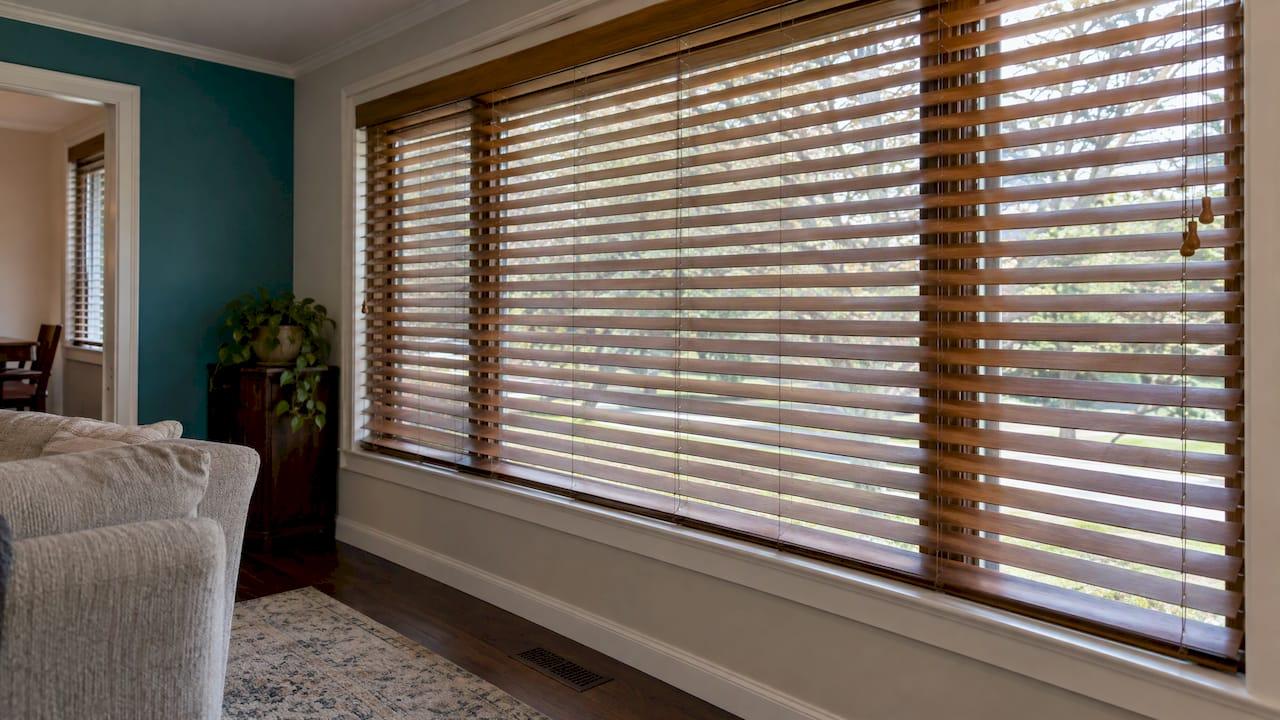
Large Window Blinds: What Works, What Affects Price, How to Measure
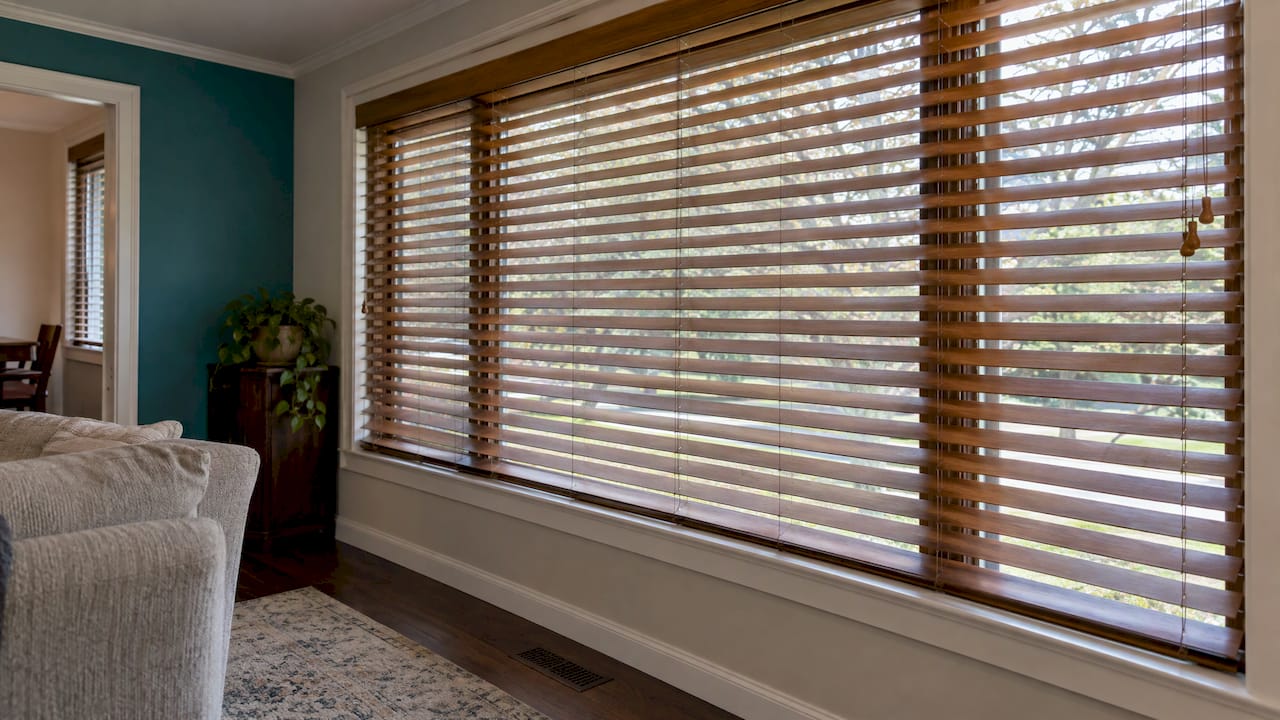
The best blinds for a large window are made to order, measured on site and sized for the opening’s width, weight and light. Stock products usually fall short on a wide or tall window. At Pinnacle Custom Window Coverings in Brentwood, a consultant brings samples and fabrics to your home, checks them against your actual windows and light, measures precisely and installs the result. Below you will find which styles suit which room, what affects price, how to measure and which controls are safe around children and pets.
TL;DR
-
Match the style to the problem: solar shades for glare with the view intact, cellular shades for insulation and dark bedrooms, wood or faux wood blinds for warmth, drapery layered over any of them.
-
Wide windows often need several panels or a custom build, because every product has a maximum width.
-
Cost depends on window size, material and motorization; we give free in-home quotes.
-
Cordless or motorized controls are the safe choice for tall windows and homes with kids or pets.
-
Measure each opening separately, at three points, to the nearest 1/8 inch.
Table of Contents
-
What Affects the Price of Large Window Blinds
Pick the style by what the window needs to do
A large window is rarely just a window. It is a view, a heat source in summer, a cold surface in winter and, in a bedroom, a source of light at 6 a.m. Start with the job, then choose the product.
Glare and heat with the view kept. Solar shades are the usual answer. Hunter Douglas’s buyer’s guide describes them as the shade for glare and UV control while keeping the view. For sunny rooms, Bob Vila’s room-by-room guide points to solar shades with a 5% to 10% openness. A lower openness percentage blocks more light and gives a darker, less see-through fabric. See our roller and solar shades.
Insulation. The U.S. Department of Energy’s cellular shades fact sheet explains that the honeycomb cells trap air and can reduce nighttime heat loss, drafts and unwanted solar heat gain. On a big pane, where the glass is the weakest part of the wall, that matters. Our honeycomb shades are made to order.
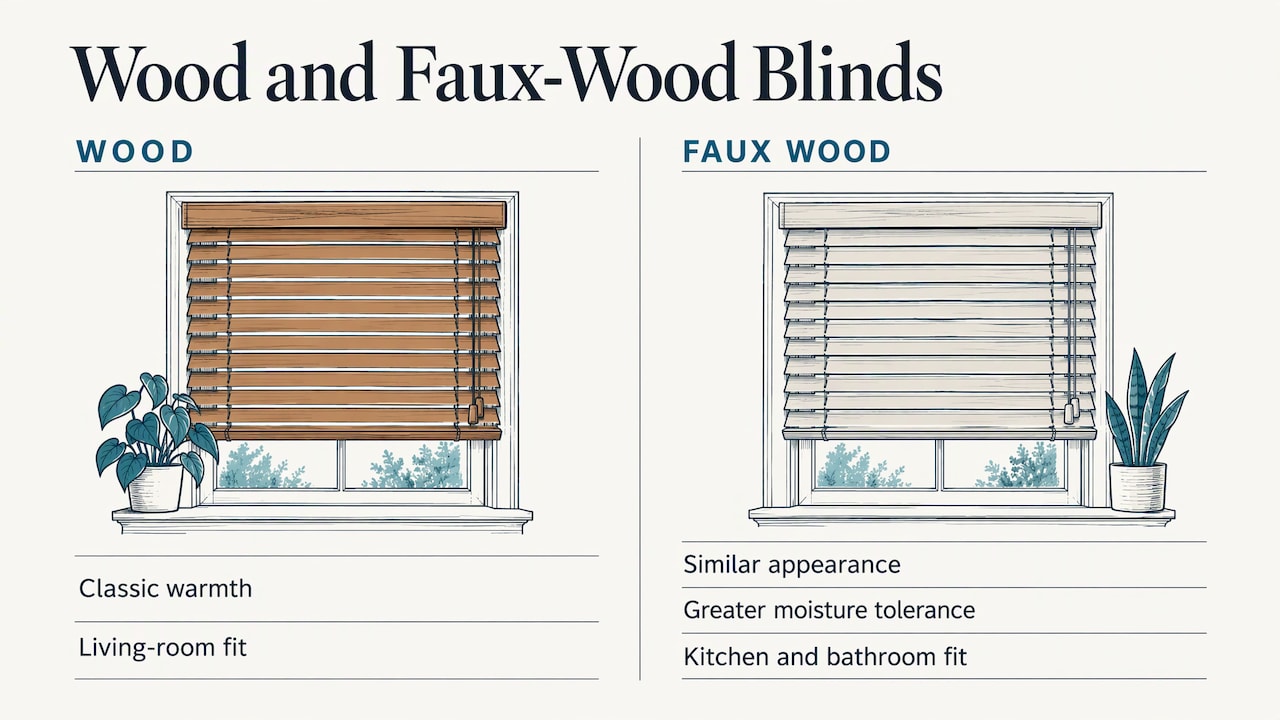
Warmth and classic looks. Wood blinds suit living rooms. Faux wood blinds give a similar look and handle moisture better, which helps in kitchens and bathrooms.
Privacy with light. Sheer shades soften daylight while keeping the room private. Hunter Douglas also lists vertical sheers for sliding-glass doors and wide windows. Browse sheer shades.
Softness and fabric. Roman shades and custom drapes bring pattern and texture to a living room or dining room. Drapery is also the layer that finishes a large window, since a wide expanse of glass can look bare with a shade alone. See Roman shades.
Which room, which covering
| Room | Good fit | Why |
|---|---|---|
| Bedroom | Cellular or roller shades in blackout fabric, layered with drapery | Darkness for east-facing rooms and street light |
| Living room | Solar shades or wood blinds, with drapery | View, glare control and a finished look |
| Sunny room or sunroom | Solar shades, 5% to 10% openness | Cuts glare, keeps the view |
| Sliding doors and wide windows | Vertical sheers or wide roller shades | Cover width with one clean sweep |
| Nursery or media room | Cordless blackout shade | Darkness without a cord |
The bedroom and living room pairings come from Bob Vila’s August 2026 guide.
Getting true blackout
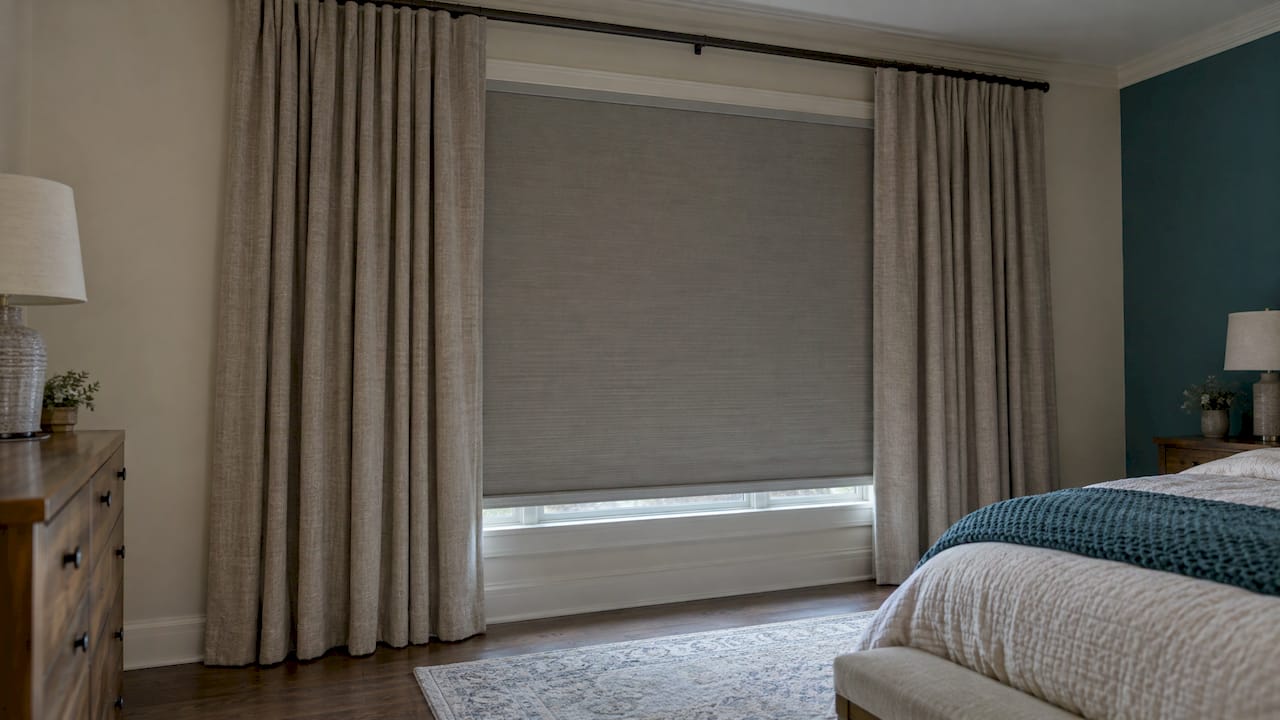
A blackout fabric alone still leaks light around the edges. Bob Vila’s guide suggests blackout-lined drapery wide enough to overlap the shade and window fully when closed. Hunter Douglas describes cellular shades with side channels for a dark bedroom. The principle is the same: close the gaps. An outside mount that extends past the frame helps for the same reason. On site, a consultant can hold up fabrics in your actual morning light, which is how you judge darkness.
One covering or several panels?
Every product has a maximum width. In one manufacturer’s January 2026 guide, Graber’s cordless faux wood blinds top out at 96½ inches for the 2-inch slat and 84½ inches for the 2½-inch slat on an inside mount, and limits vary by product and mount.
Practical rules for wide windows:
-
Split a very wide opening into two or three shades that sit side by side. Splitting keeps each panel lighter, so it lifts smoothly and puts less strain on the headrail.
-
Match the fabric run. Panels ordered together come from the same dye lot, so the color looks even across the window.
-
Consider weight. Wide wood blinds are heavy. Faux wood or fabric shades are lighter and are easier to raise.
-
Think about the motor. Large or heavy shades are ideal for motorization, which lifts them with one touch.
A picture window with a fixed center and operable sides can also be treated in sections, so you can open one side for air without raising the whole covering.
What Affects the Price of Large Window Blinds
Price rises with width and height, since fabric, slats and hardware all scale. Cost depends on window size, material and motorization; we give free in-home quotes.
Outdoor roller shades and exterior shades for patios and porches, plantation shutters and motorization are quoted individually, and a consultant prices them after seeing the window.
The factors that move a quote the most are width and height, fabric or slat material, lift system, whether you add motorization and whether the windows are hard to reach.
Measuring a large window
Bad measuring is the most common reason a large shade fails to fit. The steps below follow Graber’s measuring instructions.
-
Measure each opening on its own. Windows in the same wall can differ by a fraction of an inch.
-
Take width at three points (top, middle, bottom). For an inside mount, use the narrowest.
-
Take height at three points and use the longest.
-
Use a steel tape and record to the nearest 1/8 inch.
-
Check depth. Graber’s inside-mount faux wood blinds need 3.5 inches of minimum depth to sit flush with a valance. A shallower frame gives a partial recess.
The errors that cost money are rounding, trusting a cloth tape and forgetting depth. Because made-to-order products usually can’t be returned, a wrong number is expensive on a big window. We take on that risk: our consultant measures precisely and our team installs, so the shade is cut to the opening as it actually is.
Controls that are safe for tall windows, kids and pets
High windows are awkward to reach, and cords near a child are dangerous. The CPSC’s final rule, effective May 30, 2023, requires custom window coverings to have no operating cords, inaccessible cords, or cords 8 inches or shorter. It cites 209 fatal and near-miss strangulations among children 8 and younger from January 2009 through December 2021.
The CPSC’s goCordless page says cordless coverings are the only option that eliminates the hazard. If you have corded coverings you can’t yet replace, it recommends:
-
moving cribs and furniture away from windows
-
shortening pull cords
-
installing cord stops within 1 to 2 inches of the head rail
-
anchoring continuous-loop cords to the floor or wall
A September 2026 CPSC notice is a proposed rule, not a requirement, so the 2023 rule is what applies today.
Motorized shades for big windows
For large and tall windows, motorization is the most convenient cordless option. Brands we carry include Norman, whose motorization page describes control by smartphone, voice assistant or remote, with schedules and scenes, and notes that motorized treatments are cord-free and suit tall windows, patio doors and hard-to-reach spaces. One touch replaces a ladder and a heavy lift.
Why measure and install with a local specialist
A large window is the place where a mistake is most visible and costly: a wrong measurement, a shade too heavy for its headrail, a fabric that looks different in your light. We are a Brentwood company with 20 years in Middle Tennessee. We bring samples and fabrics to your home, compare them with your windows and lighting, measure precisely and install. We carry Graber, Norman and MidSouth Shutters, and we handle draperies, shutters and motorization, so one company can cover the whole room.
If you want a quote before booking, call us for a free in-home consultation.
We also serve new builds and new construction projects, and commercial spaces such as offices, where glare control on large glass is a daily issue. Call (615) 544-2510 or visit our site to arrange an in-home consultation.
FAQ
What is the best blind for a very large window?
It depends on the job. Solar shades keep the view and cut glare, cellular shades insulate and darken, and wood or faux wood blinds add warmth. For wide windows, two or three panels side by side often work better than one huge piece.
Can one blind cover an oversized window?
Sometimes, but each product has a maximum width. Graber’s inside-mount faux wood blinds, for example, reach 96½ inches for one slat size and 84½ inches for another. Beyond the limit, a split into side-by-side shades is the standard fix.
What affects the price of blinds for large windows?
Pricing depends on size, fabric and controls. A large window needs a custom quote, and we give free in-home quotes.
Are cordless blinds required?
Federal rules for custom window coverings, effective May 30, 2023, require no operating cords, inaccessible cords or cords 8 inches or shorter. Cordless or motorized shades meet that, and the CPSC recommends them where young children are present.
Sources
-
Interior Cellular Shades Boost Home Energy Performance (U.S. Department of Energy)
-
The Best Window Treatments for Every Room in Your Home (Bob Vila)
-
Graber Foundations Cordless Faux Wood US Price Guide, January 2026
-
Safety Standard for Operating Cords on Custom Window Coverings (Federal Register)
-
Substantial Product Hazard List: Window Covering Cords (Federal Register, September 2026)